Recruitment when it is not your day job: why good planning matters
Recruitment sounds simple until you are the person responsible for making it happen.
There is a job to fill, a panel to coordinate, applicants to assess, referees to contact, interview times to find, paperwork to complete and a delegate who needs a clear recommendation at the end.
For people who recruit all the time, this is familiar territory.
For occasional recruiters, it can feel like being handed a process that everyone assumes you understand, even when no one has actually stepped you through it.
This is especially true in public sector and local government recruitment, where the process needs to be fair, timely, well documented and defensible. You are not just choosing someone you like. You are making an employment decision that needs to be based on merit, evidence and a clear record of how the panel reached its decision.
That is where good planning matters.
Planning is not just administration
Recruitment planning is often treated as the boring part of the process.
It is the calendar invites and placeholders, the application files, panel availability changes, templates, meeting rooms, Teams links and all the paperwork that goes with it.
But good planning is not just administration.
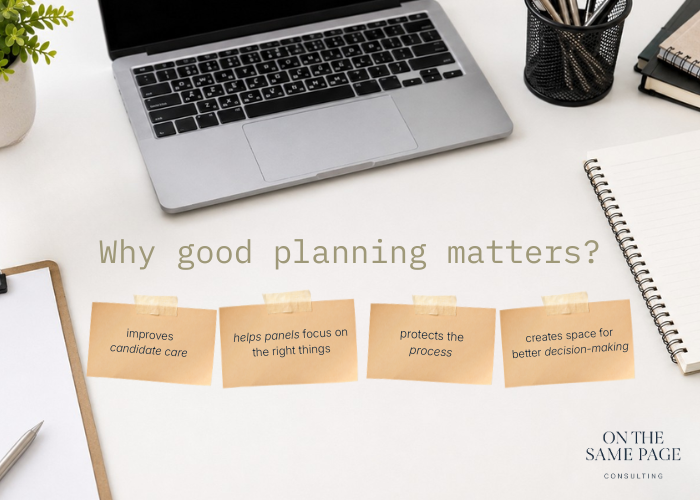
Good planning protects the process.
It helps the panel understand what needs to happen and when. It gives applicants a better experience. It reduces the risk of delays. It helps everyone see the full process before they are buried in the middle of it.
Most importantly, good planning creates space for better decision-making.
When recruitment is rushed, squeezed around other priorities or left until the last minute, panels often end up making decisions under pressure. That is when things get missed. Referees are harder to reach. Panel members are unavailable. Applicants wait too long for updates. Reports take longer to finalise. Small issues become bigger than they need to be.
A well-planned process does not guarantee there will be no problems, but it makes the problems easier to manage.
What occasional recruiters often underestimate
One of the biggest traps in recruitment is only planning for the next step.
For example:
“We will shortlist first, then work out interviews.”
“We will interview first, then chase referees.”
“We will do the report once everything else is done.”
That approach can work if everyone is available and nothing unexpected happens. But in reality, recruitment involves many moving parts. Panel members are busy. Applicants have jobs and commitments. Referees are often difficult to contact. Delegates may need time to review the final recommendation.
If you only plan one step at a time, the process can lose momentum very quickly.
A better approach is to map the whole process early.
Before shortlisting starts, it is useful to know:
when the panel will meet
who is responsible for contacting applicants
whether interview times have been protected
when referee checks may occur
whether the panel has agreed on the key assessment areas
who will prepare the report
whether there are any potential conflicts of interest
what information the delegate will need at the end.
This does not mean every detail needs to be perfect on day one. It means the panel has a shared view of the process before the pressure starts.
Good planning also improves candidate care
Planning is not only about helping the panel.
It also affects how candidates experience the recruitment process.
Applicants notice when a process feels organised. They notice when communication is clear. They notice when interviews are scheduled respectfully, when timeframes are explained and when the process keeps moving.
They also notice when a process drags on without explanation.
For government roles, this matters. Good candidates often have other options. If a process is slow, unclear or poorly coordinated, candidates may assume that reflects the workplace they are considering joining.
That may not be fair, but it is often how people read the experience.
A well-planned recruitment process sends a different message. It tells applicants that the organisation values their time, takes the role seriously and knows how to make decisions.
Planning helps panels stay focused on merit
Good planning also helps panels focus on the right things.
When a panel has not agreed on its approach early, shortlisting and interviews can become inconsistent. One panel member may focus heavily on qualifications. Another may focus on written communication. Another may be looking for direct experience in a similar role.
All of those things may be relevant, but the panel needs a shared understanding of what matters most for the role.
Before assessment begins, it is useful to ask:
what are the most important requirements of this role?
what evidence would show that an applicant can do the work?
what can be assessed through the application?
what should be explored and verified through referee checks?
These questions help reduce confusion and make the final recommendation easier to explain.
One thing to try next time
Before your next recruitment process starts, book the key stages early.
Even if the dates need to change later, put placeholders in calendars for:
shortlisting
interviews
referee checks
report review or panel deliberations.
This one step can save days, and sometimes weeks, later in the process.
It also signals to the panel that recruitment is not something to squeeze in when there is time. It is a structured process that needs attention, planning and care.
How we can help
On the Same Page Consulting supports NT Government and local government recruitment processes through practical scribing, coordination and recruitment support.
We can help with planning the process, preparing templates, coordinating panel meetings, supporting shortlisting, managing referee check logistics, documenting decisions and preparing clear recruitment reports.
We also provide practical training for occasional recruiters, panel chairs, executive support staff and teams who want to build their own recruitment confidence.
If you need hands-on support with a current recruitment process, or training to help your people recruit well, we can help you get on the same page.