The quiet skill of being a good recruitment panel chair
A good recruitment panel chair does more than keep the interview moving.
Yes, they manage the process. They keep an eye on time. They make sure questions are asked, notes are captured and decisions are made.
But the best chairs do something more subtle than that.
They create the conditions for a fair, thoughtful and respectful recruitment process.
Recently, I was reflecting on a client I love working with. I have supported a number of their recruitment processes, and I have noticed a few things they do consistently well as a panel chair.
They are not dramatic things. They are not complicated. But they make a real difference.
They acknowledge every answer as useful
One of the things this chair does beautifully is respond to applicants and referees with:
“That is really helpful, thank you.”
And the reason I like it so much is because it is true.
Whether the answer is excellent, unclear, brief, detailed, concerning or somewhere in between, it is helpful. It helps the panel understand the applicant. It gives the panel information to work with. It supports the assessment process.
It is also a simple, respectful way to keep the person engaged.
Interviews and referee checks can feel formal and uncomfortable. A small acknowledgement can help the person feel heard without giving away whether the answer was strong or weak.
I once had a boss who often said:
“That is really comprehensive, thank you.”
That phrase does not work in every situation, but it stayed with me because it showed active listening. It was a way of saying, “I have heard you. I am taking this seriously.”
Good chairs understand that how they respond in the moment matters.
They make space for other panel members
Another thing this chair does well is actively ask other panel members whether they have questions.
Not just at the end.
Not as a rushed afterthought.
They make space in the conversation.
That matters because panel members often hear different things. One person might want to clarify a technical point. Another might want to probe an example further. Another might have noticed that an applicant has not quite answered the question.
Many chairs allow other panel members to ask questions, but not all chairs actively create the space for them to do so.
There is a difference.
A good chair does not need to control every part of the interview. They guide the conversation, while making sure the full panel can contribute to the assessment.
They let others speak first
At the end of the process, this chair also lets other panel members share their views on applicants before offering their own.
That is a powerful leadership practice.
In many recruitment processes, the chair is closest to the role. They may be the hiring manager. They may know the operational context best. They may have strong views about what the team needs.
They may also know some of the applicants.
Perhaps the applicant is an incumbent. Perhaps they work nearby. Perhaps they called the chair to ask about the role before applying.
That context can be useful, but it can also carry influence.
When the chair speaks first, other panel members may unconsciously adjust their views to align with the chair. When the chair invites others to speak first, it gives the panel space to test the evidence, share independent observations and identify where views are aligned or different.
This is “leading from behind” in the best possible way.
It is good recruitment practice.
It is also good everyday leadership.
They keep the process moving
Good chairs also understand that recruitment does not only happen in the interview room.
The process works better when chairs:
respond quickly to questions from panel members, scribes and applicants
confirm panel members early so interviews can be planned while the job is still advertised
make timely decisions when things change, such as withdrawals, availability issues or question changes
approve interview questions and documentation without unnecessary delay
help keep momentum so applicants are not left waiting longer than necessary
These things may seem administrative, but they have a real impact.
A recruitment process that drags can lose good applicants. It can frustrate panels. It can create avoidable pressure at the end.
Good chairs protect the process by keeping decisions moving.
They pay attention to the human details
Good chairs also notice the practical things that affect fairness and comfort.
Can everyone hear?
Can everyone see?
Does the applicant understand who is in the room?
Has the referee been told how the conversation will work?
If the interview or referee check is being recorded, has the person been asked whether they are comfortable with that? This includes video, audio or transcript recording, especially where that has not already been clearly explained.
These details matter.
They help make the process more accessible, more respectful and more transparent.
Chairing is a skill
Being a good recruitment panel chair is not just about knowing the role well.
It is about creating a process where applicants can give their best evidence, panel members can contribute properly, and decisions are made with care.
Some of the best chairing practices are simple:
“That is really helpful, thank you.”
“Does anyone on the panel have any follow-up questions?”
“Before I share my view, I’d like to hear what others observed.”
Small phrases. Big impact.
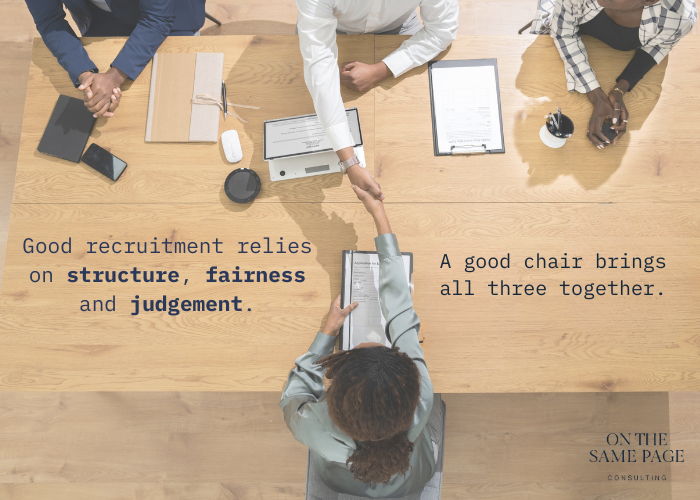
Good recruitment relies on structure, fairness and judgement.
A good chair brings all three together.