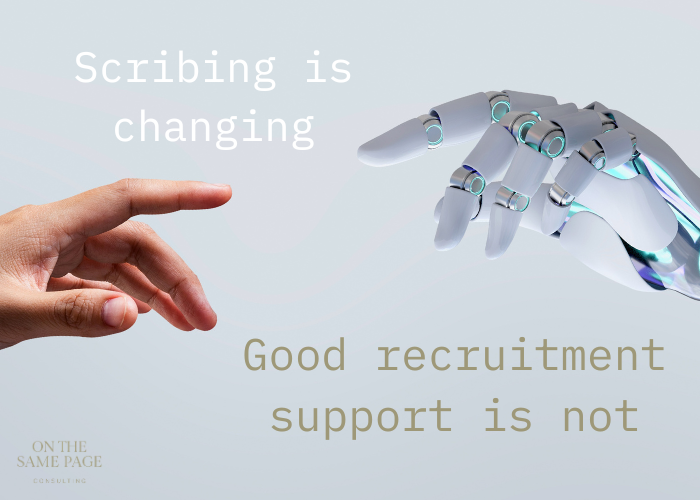
I predict that in the next few years, public sector panels will need far fewer traditional scribes.
That might sound like a strange thing to say from someone whose business is known for recruitment coordination and scribing, but I think it is true.
The note-taking part of scribing is becoming easier to automate. Microsoft’s own Teams tools now support real-time AI notes, summaries of key decisions and open questions, and meeting support features through Copilot and Facilitator. Microsoft also says Facilitator captures real-time notes and summarises decisions, while Copilot can summarise discussion points and suggest action items.
That matters because, if all you need is a transcript, rough minutes or a first draft, AI can often do that faster and more cheaply than paying a person to sit in the room and type. With strong prompts and a capable reviewer, it can also do it very well. That is exactly why I think the old version of “just a scribe” is becoming less necessary.
But that does not mean experienced recruitment support is becoming less valuable.
I think the opposite is true.
The part that can be automated
AI is very good at a particular kind of work.
It can:
capture meeting content
generate draft notes
summarise discussion
highlight action items
help structure a first draft report
That is useful. It reduces manual effort. It speeds up drafting. It can lower the cost of basic administrative support.
For many organisations, that will be enough for simple meetings.
But recruitment panels are not simple meetings.
The part that still needs judgment
In NT Government recruitment, the real challenge is rarely just writing down what was said.
The real challenge is understanding what matters, what the panel needs to do next, what should be documented, what should not be documented in the wrong way, how to sequence the process, and how to keep everything moving while staying fair, defensible and workable.
That is a very different skill set.
The Northern Territory Public Sector says selection processes should be finalised within a maximum of six weeks from the closing date of advertising unless there are exceptional circumstances, and that all applicants should receive a high standard of candidate care. The NTPS merit framework also states that selection must be based on merit, meaning suitability for the duties, workplace and public sector.
That is where experienced recruitment coordinators and panel support people still matter.
A transcript cannot manage a panel chair’s diary.
A note-taking bot cannot chase referee availability, coordinate interviews across multiple senior calendars, prepare shortlisting summaries in a useful format, assemble a report pack, manage applicant communication or sense when a panel is drifting into an approach that may be hard to justify later.
And a first draft generated by AI cannot, on its own, apply judgment about whether the report actually reflects the panel’s reasoning in a clear, balanced and defensible way.
We are not just scribes
This is the point I think the market will understand more clearly over the next few years: there is a difference between capturing content and supporting a recruitment process.
At On the Same Page Consulting, the practical support we provide often includes:
interview scheduling
referee coordination
applicant communication
shortlisting summaries
report drafting and refinement
documentation management
keeping the process moving against timeframes
That is why I do not think the future is “humans versus AI”.
I think the future is AI doing more of the raw administrative heavy lifting, while experienced people provide the judgment, structure, coordination and recruitment expertise around it.
What good use of AI looks like
I am not anti-AI in this space. Quite the opposite. Ask my team - we embrace AI and have engaged our IT firm to build bespoke automations within Microsoft to support our work.
I think good use of AI in recruitment support looks like this:
use AI for transcripts, meeting notes and first drafts
use prompts deliberately, not casually
restrict access to recordings and transcripts
separate interview content from panel deliberations where appropriate
have an experienced person review, refine and sense-check the output before it becomes part of the official process record
That last point matters.
Because the risk is not just poor drafting. The risk is poor governance.
Microsoft’s guidance makes clear that organisers can customise who has access to a Teams meeting recording or transcript, and its Copilot guidance also notes that meeting features and post-meeting history depend on transcription and access settings.
That matters enormously in recruitment.
I once heard a terrible story about a panel using recording and transcript functions in a way that exposed deliberation content beyond what should have been accessible. I am not relying on that story as a formal case study, but the lesson is still important: if you are using AI note-taking or recording tools in sensitive recruitment processes, privacy and permissions must be actively managed.
Recruitment processes involve sensitive personal information, panel views, referee comments and assessment reasoning. Those are not things to leave sitting in a poorly configured recording environment.
Better support means better candidate care
There is another reason this matters.
Slow, messy or poorly coordinated recruitment does not just frustrate panels. It damages the experience for candidates too.
And candidate experience is not a soft issue. It affects organisational reputation.
The NTPS publicly states that applicants should receive a high standard of candidate care. When processes drag out, communication is patchy or coordination is clunky, that standard becomes harder to achieve.
If the Northern Territory Government wants to improve its reputation as an employer, part of that work sits in the quality of recruitment process support.
Not just the decision.
The process.
What experience changes in practice
In many processes where the chair is using this type of support for the first time, the feedback is not really about the notes. It is about how quickly and efficiently the recruitment was coordinated and how much easier the panel found the process.
That is the difference.
One example that stands out to me was a bulk recruitment process for 21 positions completed in the three weeks before Christmas 2024. That outcome was not about typing speed. It was about planning, coordination, communication, follow-through and knowing how to keep momentum in a difficult window.
That is why I think this conversation matters.
If all someone needs is a transcript, AI will increasingly do that job.
If what they need is real recruitment support, that is a different proposition entirely.
The shift ahead
Over time, I think “scribe” will become too narrow a word for the work that really helps panels.
Basic note-taking will be automated.
Basic drafting will be automated.
But experienced support that helps panels move efficiently, stay aligned with process requirements, protect candidate care and reach clear, well-documented decisions will become even more important.
That is the real opportunity.
Not to resist AI.
To use it well, while being very clear about the difference between technology that captures the conversation and expertise that helps a panel run a better process.
AI may be able to capture the conversation, but experienced recruitment support helps panels move faster, make better decisions and deliver a process people can trust.